
When a tractor or harvester is out in the field, every minute of operational uptime counts. However, heavy-duty agricultural environments are notoriously harsh. Agricultural steel wheels are constantly subjected to immense structural loads, extreme torsional vibration, high-moisture soils, and highly corrosive chemical fertilizers.
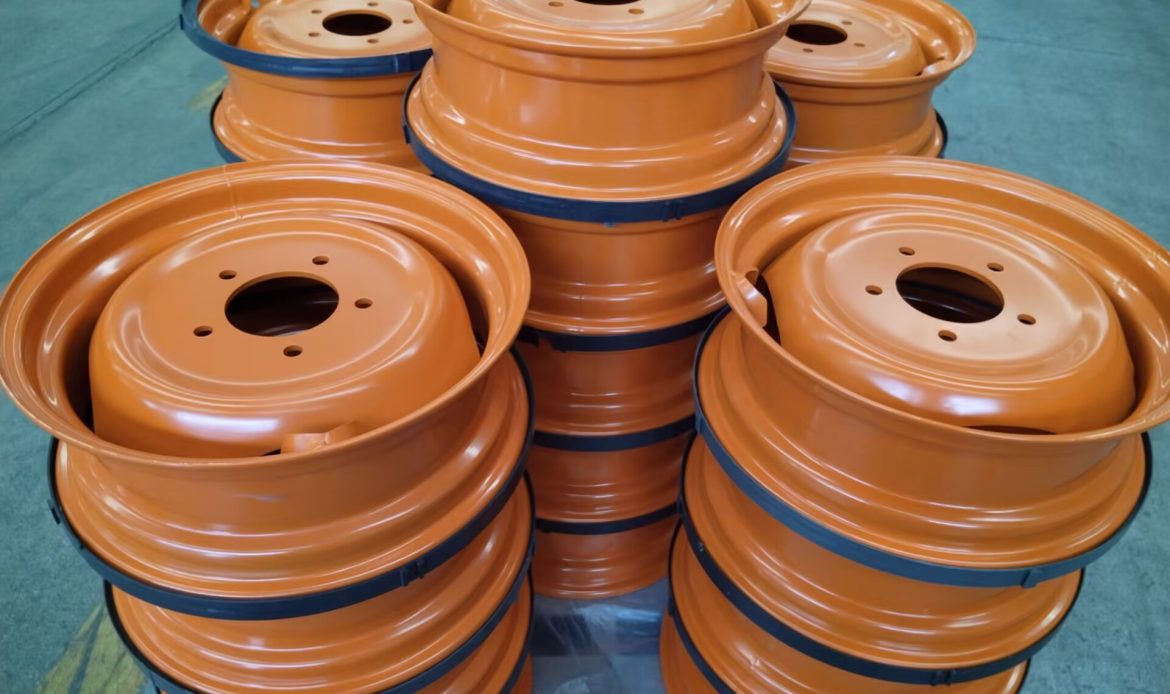
For international distributors, importers, and agricultural machinery OEMs, premature wheel failure—such as structural cracking along weld seams or severe rust—leads to costly warranty claims, customer dissatisfaction, and expensive farm downtime.
At Shandong Chenhua International Trade Co., Ltd., we believe a wheel should never be a weak link. To guarantee zero-wobble and premium anti-corrosion performance, we focus on engineering quality right at the foundational manufacturing level.
Here is a technical inside look at how our advanced production processes secure your supply chain and protect your machinery investments.
1. Robotic Arm Welding: Eliminating Structural Weak Spots
The joint connecting the inner steel disc and the outer rim absorbs the majority of a tractor’s operational stress. Traditional manual or semi-automated welding is prone to human error, localized overheating, and hidden micro-porosity, which can lead to fatigue cracking under heavy loads.
To solve this, our factory utilizes fully automated CNC robotic welding cells.
Perfect Consistency: The robotic arms operate at an unvarying travel speedS and optimized torch angles, eliminating human variance completely.
Deep Root Fusion: Continuous, automated multi-pass seams deliver absolute structural uniformity and deep thermal fusion with the steel substrate.
Zero Micro-Cracks: This flawless geometric execution ensures that the stress is evenly distributed across the entire profile, effectively maximizing the wheel’s structural lifecycle.
2. Multi-Stage Pre-Treatment: Chemical Pickling & Phosphating
Many commercial wheels look good on the surface, but rust from the inside out within a single farming season. This happens because the powder coat or paint was applied over hidden raw steel oxides or manufacturing oils.
Our multi-stage pre-treatment line completely eliminates this risk before a single drop of paint is applied:
Chemical Pickling & Descaling: Steel rims are completely submerged in specialized chemical baths to strip away all mill scale, processing oils, and microscopic oxides.
Micro-Crystalline Phosphating: The pristine steel then undergoes a controlled chemical transformation, creating a tight micro-crystalline phosphate layer. This layer acts as a powerful mechanical anchor, allowing the final coating to bond molecularly with the steel and preventing future paint peeling or chipping.
3. Electrostatic Powder Curing: The Ultimate Field Armor
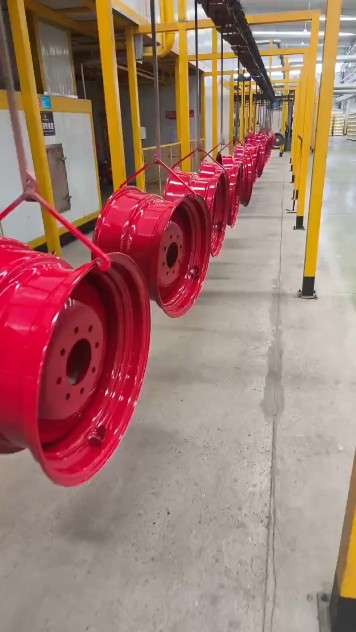
Once the steel substrate is chemically optimized, the rims enter our automated electrostatic powder coating cells and thermodynamic baking tunnels.
Instead of standard cosmetic liquid paint, we apply a heavy-duty, UV-resistant industrial powder finish. The powder is electrostatically charged to wrap uniformly around every edge, contour, and bolt hole of the wheel. Cured at high temperatures, it forms a rock-solid protective shield that stands up against flying stone chips, thick mud, heavy friction, and aggressive chemical abrasion from fertilizers.
Standardizing Quality for Global Supply Chains
Every custom specifications and OEM order at Chenhua is manufactured strictly under long-standing IATF 16949 automotive-grade quality protocols. This rigorous engineering process is exactly why international buyers from the Russia, Uzbekistan, and South America trust our components for their fleets.
We prioritize precise technical blueprint engineering, custom offsets, and flawless manufacturing repeatable quality over general stock shortcuts. Partner with a manufacturing expert that values the engineering physics of farming.
Are you looking to secure your supply chain with premium, long-lasting agricultural wheels?